Thursday, June 4, 2020

Namid Observatory

Weather, Work, Covid-19... somehow I didn't do any real imaging (did some maintenance and configuration though) the entire winter and spring.

BUT!!!

Late last year, I decided to setup a remote observatory with Manoj and Rich - two other astrophotography enthusiasts. We decided to go for a long focal length (maybe adding a widefield later on top):
  • scope: Planewave 14" CDK
  • mount: 10Micron GM 3000 HPS
  • camera: FLI ML50100
The mount is overdimensioned for the scope (the 2000 mount from 10Micron would have ad enough loading capacity) but we wanted it to be super solid.

With the help of Tolga (from https://www.tolgaastro.com/) we then designed everything around it:
  • Moonlite Nightcrawler WR35 focuser
  • FLI CFW10-7 filter wheel with 62mm square filters (LRGB, Ha, SII, OIII)
  • Takahashi Starbase 80 scope as guidescope
  • ASI178 guide camera (actually, Manoj won this at AIC and it just fit well :-)
After some investigation, we selected Dark Sky New Mexico as our site. It had good reviews, was fairly well accessible (4.5 hour car ride from Phoenix, AZ) and the price was right!

Richard came up with the name Namid - which means dancer or star dancer in Native American.

We bought and shipped everything and planned to set it up in February or March ... and then Covid-19 happened. For several months, our awesome equipment sat unused at the site or at boxes in our houses :-( Once things looked up, we decided to travel early June to set it up!!! (unfortunately, Manoj had some surgery upcoming and couldn't join us :-(

Next: Travel

Saturday, November 23, 2019

Using AllSky search from Model Creator

Often, when I setup my scope in a new location, plate solving with TSX fails because the alignment is too far off. I always wished for an option in ModelCreator to use AllSky search (similar to how ModelCreator allows to select "Blind" search in SGP).

... and in one of my recent frustrating nights where I couldn't get plate solving to work, I found this option:

It's kind of backwards that I will have to select it in TSX. But it totally works - yei!!!

... I just have to remember to switch it back once my scope is aligned fairly well - Regular Plate solving is MUCH faster!!!

Sunday, November 17, 2019

RigRunner woes

A few weeks ago, one of my 10Micron mounts started to experience short outages. I suspected that it was the 12V power supply and started using the 110V power supply. Everything worked fine ...

Then, when I was at Richard's ranch, the NUC on the same mount didn't turn on (or briefly turned on and turned off right away again). When I measured the voltage, it was well below 12V. I suspected that the DC/DC converter has some issues. Luckily, I could power it from the other mount.

Back home, I ordered a new DC/DC converter. It came a few days later, I installed it ...
... and the same problems.

Now, I did some more intensive measures and realized that the DC/DC converter was fine, but for some reasons, the RigRunner would output lower voltage. And I remembered that the RigRunner got soaked a few months back when it was raining ...

So, I ordered a new RigRunner. In the meantime, I just used a simple power distributor between the DC/DC converter and all the equipment (mount, NUC, camera, filter wheel...).

And suddenly the almost brand new FLI ML16200 camera acted up. Every now and then, it would stop working. Sometimes I could reconnect it and it worked, sometimes I had to restart the camera, sometimes reboot the computer to make it work. I was almost ready to contact FLI ...

... but then the new RigRunner arrived and I wondered if it provides a more stable output to all cables. When the camera downloads the image, the computer needs more power at the same time to store the image.

And, yes, that was it. With the RigRunner in place, all components now work smoothly again. Yei!

Saturday, September 7, 2019

The Cygnus Loop

This large nebula is a supernova remnant in the Cygnus from a star explosion 21,000 years ago. It has a visible size of almost 3 degrees (the moon is roughly 0.5 degrees!)

(click on image for full resolution)

Lots of interesting details in this large image:

The Eastern Veil

Pickerings Triangle

The Witches Broom


The nebula is 2,400 light years from earth (the initial estimate in 1958 was 2,500 light years, it was then revised to 1,470 light years in 1999, then to 1,760 light years and most recently to 2,400).

This puts the diameter of the nebula to 130 light years and expansion rate of 60 miles per second.

This is a mosaic of two images - each having close to 30 hours imaging time. The real time to take the data was almost twice as long as I had a lot of trouble with my 10Micron mount. I think I coult finally fixed it...

Sunday, January 6, 2019

Nebulae and terrestrial objects

During the holiday break, I cleaned up my Google Drive and found an interesting gem!

When I used my ultra-wide field setup with a Pentax lens, I sometimes captured some nebula in Ha together with terrestrial objects. Mostly during focusing or model building.

I like these images as they make these nebula look more connected to us on earth!
The Cygnus Loop over our house

The Seagull Nebula in a tree

"some other nebula" over our house.

I might try to take more of such images.

SH2-170 (The Small Rosette Nebula)

This nebula (which is also cataloged as LBN 577) in Cassiopeia is surprisingly dim. Despite taking more than 50 hours of data, I still had to be very careful when processing it.
(click on image for full resolution)

The nebula is about 7500 light years away in the Perseus arm of our galaxy.

Sunday, September 30, 2018

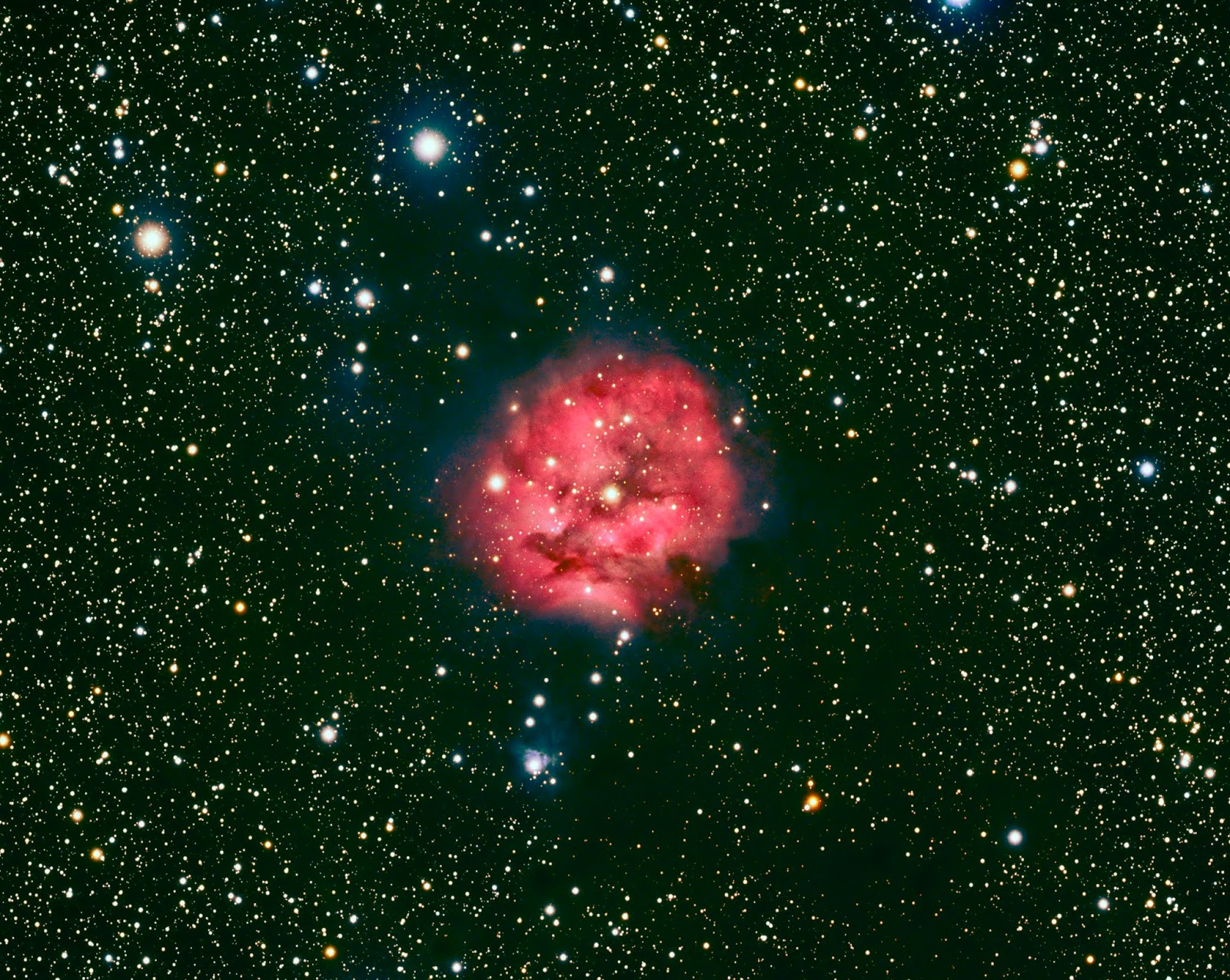
IC 5146 - The Cocoon Nebula


The Cocoon Nebula is an emission and reflection nebula in Cygnus. It is 4000 light years away and spans 15 light years across (it has a visible size of 12 arc minutes - the full moon is 31 arc minutes).
(click image for full resolution image)

The brightest (red) parts of the nebula is the emission part - the darker parts with the blue hue are illuminated by the central star with the unassuming name "BD +46°3474". It's a very young star (~100,000 years!), it is 5 times larger than the sun, has 15 times the mass of the sun and shines 20,000(!!) times brighter!!! The nebula is very young - many stars are still "pre-sequence" stars (i.e. they are not shining visibly yet).

Processing this image was challenging because of the bright emission parts and the darker dust lanes around it. In my initial attempt, I focused too much on the bright, red part and its details and cut out almost all of the dust lanes:

I found it surprisingly difficult to process this image better. In order to do that, I tried out a couple of new things:

  1. Using the NBRGBCombination script in Pixinsight
  2. Carefully adjusting color levels using CurvesTransformation to bring out the red in the core and the blue in the faint regions
  3. Using a very fuzzy mask for processing the core that slowly increases protection over the faint, outer layers.